Awaken The Dragon
If you make a mental list of all those things that make you 'well', there is a good chance that 'seeing your doctor' and 'taking medication' is probably not in the top five. We know there is more to health than medicine, and doctors know this as much as anyone else. In fact, being well often involves really very simple things and doing or taking less, rather than adding more and more. So why do we continue to seek in medicine a cure for our ills?
Perhaps one reason is that modern medicine has been so successful. Our drugs and interventions mostly work. Daily pills help to reduce the risk of disability and death for millions of people the world over. Anti-retroviral drugs in the treatment of HIV are the unsung success story of modern medicine. Surgeons have patients up and out of bed within weeks after operations, where in the past they would have emerged from months of bed rest as shadows of their former selves, if at all.
That said, it is also true that the majority of a person’s well-being is thanks to factors beyond medicine. Public health, sanitation, immunisation, green spaces, community and economic equality all play a significant role in our health. But these are very much pushed to the background in our culture; they make for less interesting TV, and prevention or a walk in the park with a friend is not as exciting as finding that 'hidden' diagnosis, that miracle cure.
Modern medicine is not the problem, but its very success can limit our view. It is based on a view of the human being - sometimes called the ‘biomedical’ view - that the body is a physical reality composed of tissues and organs and systems which, whilst obviously interacting, can be viewed as separate entities.
This is necessary. We humans are ridiculously complex. In some respects the only way we can understand our body is to separate its component parts and systems, and then categorise and label them. In fact this is generally how we deal with reality and mostly it works very well.
But it is worth remembering that this separation of reality is entirely in our minds. A label is not the thing. It is a symbol which we use to try and describe experience. Labels can be helpful, but they can’t describe experience any more than we can describe a moving van by throwing paint at it.
This separation of reality into separate entities also changes how we approach problems. We end up trying to locate the source of the problem in the thing we are dealing with. We then try to fix the thing. We may deal with the problem temporarily, but another will soon take its place if we not also looking at the system it emerged from.
By seeing the problem as an entity rather than part of a system, we are not really understanding it. If we can truly understand the system, we often gain such a degree of clarity that the problem ‘fixes’ itself. It is as if, by getting a clear view of the problem as a manifestation of a system the problem dissolves into that system and, as the system-theorist Anthony Stafford Beer put it, ‘it is better to dissolve problems than to solve them.’
The key to understanding systems, a secret known to both mystics and physicists alike, is that reality is not made of separate things. Reality is more accurately seen as a vast interwoven set of relationships. Some of these relationships form systems. Not everything is a system though. A rock for instance is just a rock. But if there is a part of reality that shows some pattern of behaviour that persists over time and survives despite challenges from the environment, then we have a system. A successful system is able to continually adapt to the environment and other systems.
Seeing the relationships, the flows of information that connect the system, is not always easy. While things and entities can be seen, heard, felt and so on, relationships usually have to be inferred. Relationships are also dynamic. They change moment by moment, and feedback to other parts of the system, which changes the system yet again.
In general we are not conditioned to see reality in this way. We prefer to see reality as a collection of things all knocking about. We explain why things happen with stories. We see chains of cause and effect rather than cycles and patterns, and we see problems as caused by people rather than the system they are part of.
An important insight we gain when we step back and look at the system is that they usually have some purpose. This may be an explicit aim such as to win the most goals in a game of football, or a kind of unconscious function like the orbits of planets in the solar system. These aims usually manifest through rules of the systems. These rules can be thought of as flows of information or force between parts of the system - rules in football, gravity in planets.
Change the parts or change the rules. I’m sure you can guess which is more powerful. Let’s say a city major may want to reduce road accidents. They might try to increase police patrols or roll out an expensive road safety campaign. This will cost a lot of money and may work for a few weeks. Or they change the rules of the system, a say mandatory speed limit of 20mph. This was done in London a few years back, with significant success. Here it is worth noting that physically not much happened, except for having to add signs on the road. Changing something did not require a large material expenditure, just a change to the information flows, essentially a switch to more precise instructions.
Similarly if an organisation wants to improve safety it can mandate any number of training programs, draw up complex charts to designate who is responsible when something goes wrong and generally exhort the workers to manage risk themselves. All very stressful, and does little to prevent mistakes. Or the organisation can build risk management into its system by having secure rules - more precise instructions - and ensuring that everyone has the resources to do their job, so that it is virtually impossible to make a mistake - as they do in the airline industry. The reason this latter approach is far more effective is because it is viewing risk through a systems, rather than individual lens.
Returning to questions of health. When, as we often do we find ourselves wanting to change something about ourselves, we also tend to adopt an ‘individual’ approach. We want to change some ‘thing’: how we look, how much muscle we have, our weight, our energy levels and so on. And of course this is often why we see the doctor, for some test or tablet to try to change those ‘levels’. We are trying to alter some stock. However, as we shall see, it can be far more powerful to look at the ‘rules’ that govern our systems: the flows of information, the core beliefs, the relationships we are part of.
Let’s take an example of a common human need: rest. What, for you, is ‘rest’? Is it just recharging for work or so you can be more productive? When this is the ‘aim’ of rest it functions very differently as to when we see rest as, for example, simply being present, for ourselves or other people. If we can change the purpose of rest, and see it as being present, rather than a guilty or selfish break, or as something we need to do to make us more productive, this will profoundly affect the quality of our rest. It becomes a part of our daily lives rather than some thing that we can never quite get enough of.
Or, let us say I adjust one of my aims from wanting to look a certain way to wanting to feel a certain way. In the second case I am no longer chasing an external ideal, but connecting with what is already there. Or if I replace telling myself ‘I need to exercise more’ with something subtler like ‘I want movement to be a part of my life’, then my lifestyle will change in accordance to this aim. Rather than forcing myself to exercise and having to constantly expend willpower, which is hard-earned and easily spent, I might find some activity I actually enjoy, which will sustain itself.
This approach follows the Taoist principle of Wu Li. One interpretation of this phrase is the observation that in nature things seem to grow from the inside to the out, much like a leaf or feather grows outwards, often from some quite simple rules, to something diverse, complex and perfectly suited to its role. We can apply the same principle to our own well-being. Rather than imposing our ‘will’ on ourselves, attaching to some idea and striving towards it - as is very ingrained in our culture - we instead discover our core beliefs and aims and adjust those. In this way we let ourselves grow and develop rather than trying to get to an elusive endpoint.
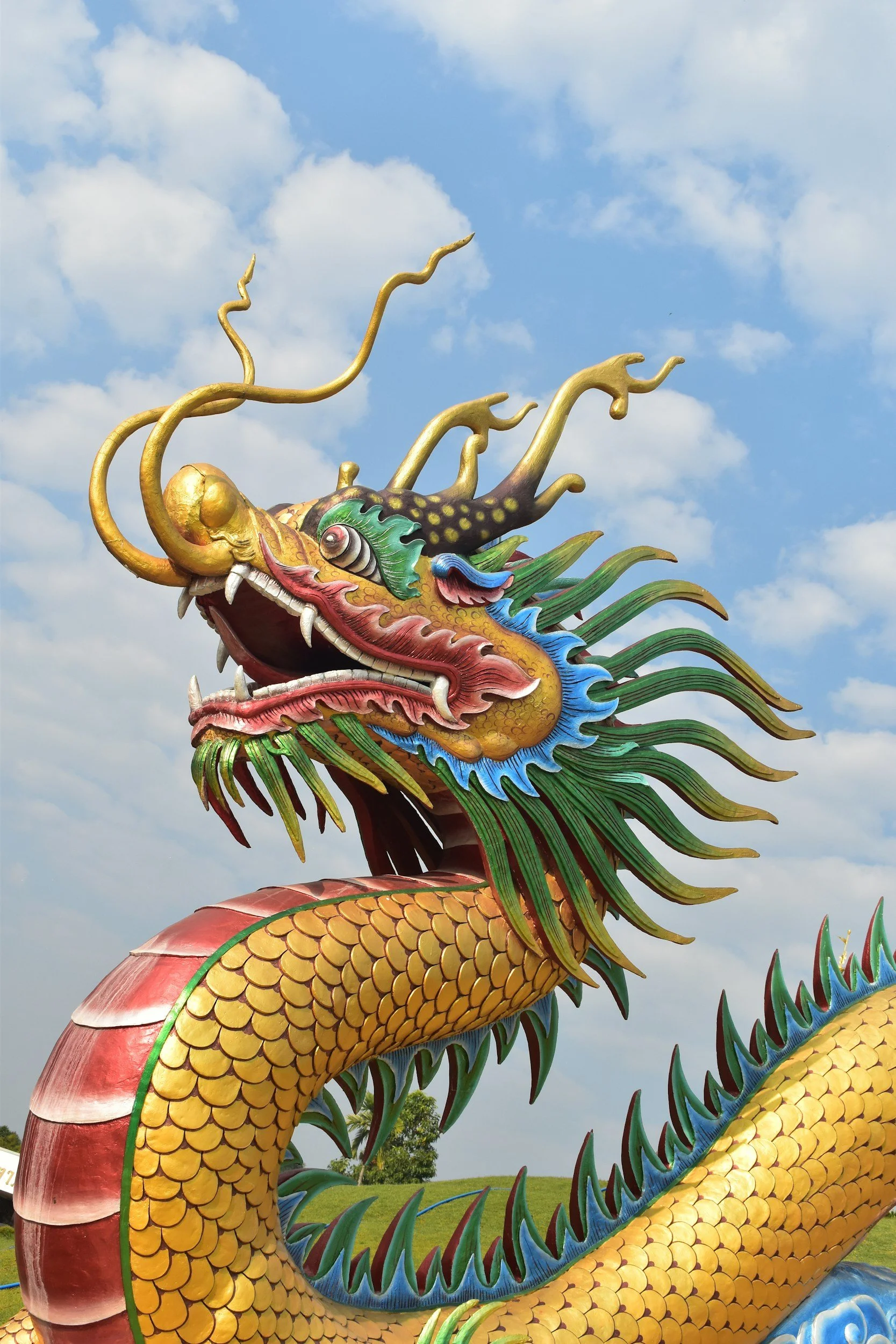
I like to think, maybe a little poetically, that the aims of the systems are the hidden dragons. They are the ideas or goals that direct the flows which ultimately dictate the behaviour of the system. These may be of the mind or the body, it doesn't really matter as they work in the same way. These dragons may be slumbering, we may be completely unaware of them, or they may be shackled by the rules and aims imposed on us by our culture, or we impose on ourselves. In any case they are a metaphor for the potential power we have at our disposal when we can find and awaken them.